


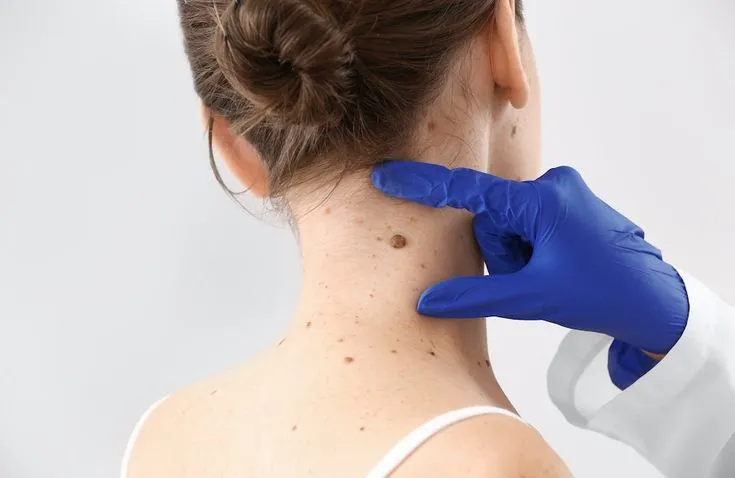
Dermatologist-Led Skin Clinic Dermatologist-Led Skin Clinic · Saravanampatti, Coimbatore
Mole Removal in Coimbatore
Every mole assessed first, against recognized warning signs — with a biopsy where appropriate — before any removal technique is chosen.
Quick Answer
Mole removal at LaShine Skin & Hair Clinic, Saravanampatti, Coimbatore starts with checking the mole against the ABCDE warning signs — asymmetry, border irregularity, color variation, diameter over 6mm, and evolving/changing appearance. Stable, benign-looking moles are typically removed in one session (occasionally two) using shave removal or surgical excision, with mild healing over a few days. Any mole showing warning signs is biopsied first, since accurate diagnosis matters more than immediate removal.
Why Patients Choose LaShine for Mole Removal
No mole is removed before it's properly assessed — here's what backs your removal decision at LaShine.

Saravanampatti
Coimbatore
IADVL Certified Dermatologists
Every mole is assessed before any removal decision — never a fixed cosmetic package applied without a look.
Biopsy-First for Changing Moles
Never removed without a closer look if something looks unusual — diagnosis always comes before removal.
Right Technique for Your Mole
Shave, excision, or another method, chosen by appearance and depth, not a one-size-fits-all approach.
Hygiene-First Clinic
Medical-grade sterilization for every procedure.
One assessment. Then the right technique, confirmed.
Bring your mole to LaShine Skin & Hair Clinic, Saravanampatti, Coimbatore.
What Is Mole Removal?
Mole removal at LaShine begins with an assessment against the ABCDE rule — a standard framework doctors use to flag moles that need a closer look. A stable mole that doesn't raise any of these flags can typically be removed directly, using shave removal or surgical excision depending on its depth and location.
A mole that does raise a flag is referred for a Skin Biopsy first, so removal is never a substitute for finding out what the growth actually is. This diagnosis-first approach is deliberate — dermatologists generally avoid removing moles with methods like cryotherapy or laser precisely because those techniques destroy tissue rather than preserving a sample, which matters if a biopsy later turns out to be needed.
- AAsymmetry
- One half doesn’t match the other
- BBorder
- Irregular, ragged, or blurred edges
- CColor
- Uneven shading or multiple colors
- DDiameter
- Larger than roughly 6mm
- EEvolving
- Changing in size, shape, or feel
Any one of these five flags is worth having assessed rather than removed straightaway — it's what decides between direct removal and a biopsy first.
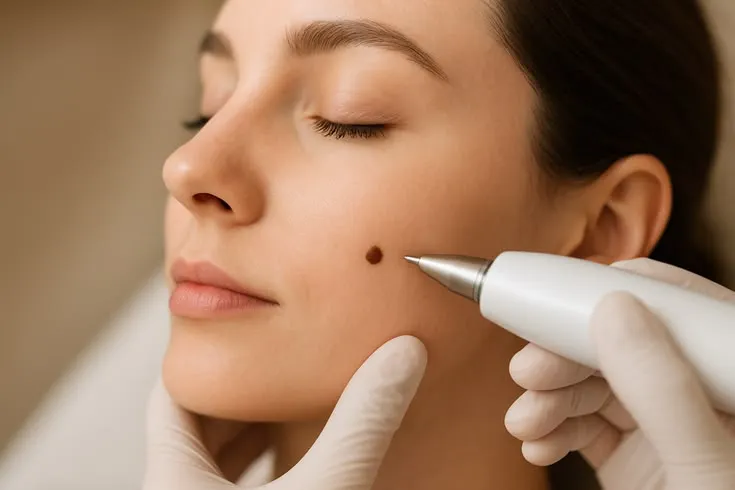
Who Is It Suitable For?
A stable mole you'd like gone, or a mole that's changed and needs a proper look — both start with the same assessment. Your dermatologist decides which path applies.
Not Sure If It's a Mole at All?
If you're unsure whether what you're looking at is a mole, skin tag, or wart, see the hub's Mole vs. Skin Tag vs. Wart guide, or start with a Skin Biopsy if it's changed recently.
Stable, Longstanding Mole
Cosmetic or comfort reasons — bra strap, collar, waistband
Mole That Has Changed
Size, shape, color, bleeding, or itching — assessed, not removed immediately
Raised Mole, Shave or Excision
Depending on what your dermatologist recommends
Unsure What You’re Looking At
Mole, skin tag, or wart
Who Should Be Cautious, or Know the Limits
ABCDE Warning Signs Mean Evaluation First, Not Direct Removal
Any mole meeting an ABCDE warning sign should be evaluated before removal — this is the single most important caution on this page.
Biopsy Needed? Excision, Not Shave Removal
Full surgical excision, not shave removal, is the appropriate method whenever a biopsy is needed, since it provides a complete tissue sample for pathology.
Scarring Isn’t Guaranteed to Be Zero
This depends on mole size, depth, location, and how well aftercare is followed — your dermatologist sets realistic expectations for your specific mole.
Regrowth Is Uncommon, but Should Be Reported
Mole regrowth after a full, proper removal is uncommon — if it does happen, report it to your dermatologist promptly rather than treating it as routine.
Home Remedies Aren’t a Safe Alternative
Creams or acids for mole removal are not recommended and can cause burns, scarring, or delay a diagnosis that mattered.
How We Treat Step by Step.
A five-step approach at LaShine — from the ABCDE visual assessment to a biopsy decision (if needed) and the removal itself.
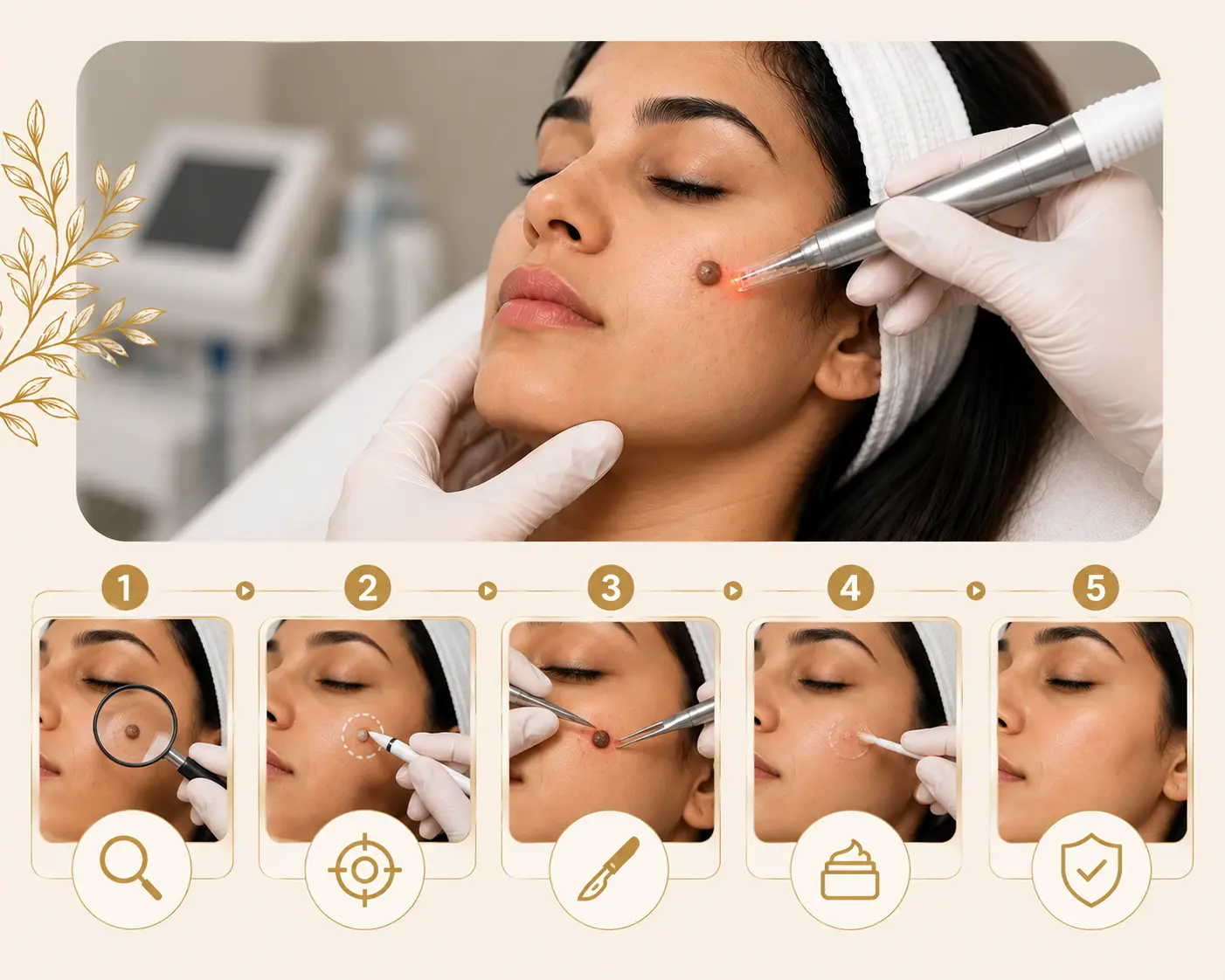
Visual Assessment
Your dermatologist examines the mole against the ABCDE warning signs and asks about its history — when it appeared, whether it’s changed, whether it causes discomfort.
Biopsy Decision
If anything looks unusual, a Skin Biopsy is recommended before or as part of the removal, so a tissue sample can be properly examined. If the mole is stable and benign-looking, removal can proceed directly.
Numbing
The area is cleaned and injected with a local anesthetic, so the removal itself is comfortable.
Removal
Depending on the mole’s depth and whether a biopsy is needed, your dermatologist uses shave removal (a fine blade level with the skin, no stitches) or surgical excision (removing the mole with a margin of surrounding tissue, sometimes needing stitches).
Review & Healing Check
A follow-up confirms the area is healing well, and biopsy results (if taken) are discussed once available.
A typical removal is 1 session, occasionally 2, planned only after the ABCDE assessment.
What to Expect, At a Glance
A quick reference for a stable, benign-looking mole — book a consultation if your mole shows any ABCDE warning sign instead.
Typical Course
1 session, occasionally 2
Downtime
Mild — a few days of healing, longer if excision with stitches was needed
Best For
Raised, flat, or changing moles
Not a Fit For
Any mole flagged by the ABCDE rule — this group needs assessment (and often a Skin Biopsy) before removal is even discussed as a next step.
Realistic Results & Timeline.
The mole is visibly gone right after the procedure — the healing, any biopsy result, and scar fading each follow their own timeline.

Gone immediately, heals in 1–2 weeks.
Mole Visibly Gone Immediately
For a straightforward shave or excision, the mole is visibly gone right after the procedure.
Healing Within One to Two Weeks
The treated area typically heals within one to two weeks, depending on technique and location.
Biopsy Results Within Days to a Week
If a biopsy was taken as part of the removal, results are usually available within a matter of days to about a week.
Scarring Fades Over Following Months
Scarring, if any, tends to fade and flatten over the following months with aftercare followed as advised.
Heal Well. Minimize the Mark.
A few consistent habits after removal reduce scarring risk and help you catch anything unusual early.

Don't pick, let it heal.
Keep the Area Clean & Covered
Avoid picking at any scab, since this increases scarring risk more than almost anything else in the healing process.
Sun Protection Once Healed
Apply sun protection to the healed area once it’s closed, since fresh skin re-pigments more easily than surrounding areas.
Avoid Swimming, Saunas & Sweat
Skip activities that could get the area dirty or overly sweaty until it’s fully healed.
Keep Your Stitch Removal Appointment
If stitches were placed, keep to your scheduled removal appointment rather than removing them yourself.
Contact Us If It Looks Infected
Increasing redness, pus, or worsening pain should be reported right away rather than waiting for your next scheduled review.
Questions About Aftercare?
Our team will walk you through exactly what to do while the area heals.
Expert Care. Assessed Before Anything Is Removed.
Every mole at LaShine is checked against the ABCDE warning signs by a qualified dermatologist before any removal technique is chosen — with a biopsy recommended first whenever a mole's appearance calls for it.

Dr. Shabari A, MBBS, MD DVL
Dermatologist & Cosmetologist
Completed her MBBS and MD in Dermatology, Venereology & Leprosy, with 9 years of overall experience assessing and removing moles and other skin growths using minor dermatological surgery.
Most moles patients bring in are perfectly stable and safe to remove directly. My job is to catch the small number that aren't — the ABCDE rule isn't a formality, it's what decides whether we remove today or biopsy first.
MBBS, MD DVL
Dermatology, Venereology & Leprosy
9 Years
Overall Clinical Experience
Specialized In
Mole & Skin Growth Removal
Evidence-Based
ABCDE Assessment, Biopsy-First
Patient-First
Personalised, Coordinated Care

Dr. Lavanya Kavimani, MBBS
Dermatology Care, IADVL Member
Completed her MBBS at Tbilisi State Medical University in 2018, and is a registered member of the Indian Association of Dermatologists, Venereologists and Leprologists (IADVL).
A mole that's changed shape or color deserves a proper look before anything is done to it — removal can wait a week for a biopsy, but a missed diagnosis can't be undone.
MBBS
Tbilisi State Medical University, 2018
Registration
134837 — Tamil Nadu Medical Council, 2019
IADVL Member
Indian Association of Dermatologists, Venereologists & Leprologists
Specialized In
Mole Assessment & Removal Care
Patient-First
Approach with Personalised Care
Frequently Asked Questions
Your questions about mole removal, answered by our experts. Clear answers. Real guidance.
Still Have Questions?
Speak to our dermatologist and get an honest assessment of your specific mole.
Book a ConsultationDermatologist Supervised Medical-Grade Care
Cost varies by technique and whether a biopsy is needed. Book a consultation for an accurate, current quote based on your specific mole.
Use the ABCDE rule as a guide: asymmetry, an irregular border, uneven color, a diameter larger than about 6mm, or any recent change in size, shape, color, or sensation (bleeding, itching). Any one of these is worth having assessed rather than removed straightaway.
Some mark is possible, but for most stable moles removed with proper technique, it fades to something you’d have to know to look for. Bigger, deeper moles or ones needing surgical excision with stitches are more likely to leave a visible line than a simple shave removal would.
No — home remedies like creams or acids aren’t proven to work safely and can cause burns, scarring, or delay finding out something that mattered. Professional evaluation is the safer route every time.
Shave removal takes the mole down to skin level with a fine blade and needs no stitches, suited to raised, clearly benign moles. Surgical excision removes the mole along with a margin of surrounding tissue and may need stitches — this is the method used whenever a biopsy is required.
It’s uncommon after a proper, complete removal. If it does happen, this should be reported to your dermatologist rather than assumed to be normal.
Your dermatologist examines the mole against the ABCDE warning signs, discusses its history, and recommends either direct removal or a Skin Biopsy first — before any procedure is scheduled.
We're Here to Help
Not sure if your mole just needs removing, or checking first? Book a consultation with our dermatologist today.
Related Treatments
Explore other ways we treat removal procedures alongside Mole Removal.
Related Categories You May Also Need
Not sure if that growth needs removal?
Start with a full skin assessment — your dermatologist maps the right combination before recommending anything.
Not Sure If Your Mole Just Needs Removing, or Checking First?
If you’re concerned about your skin, hair, or health, we’re here to help with expert treatment. Book a private consultation at LaShine Skin & Hair Clinic in Saravanampatti, Coimbatore. Your dermatologist can guide you through symptoms, appropriate testing, diagnosis, treatment and follow-up.
Mole Removal Care Across Coimbatore
Patients visit LaShine Skin & Hair Clinic in Saravanampatti from across Coimbatore for personalised Mole Removal and professional dermatologist-led care.
- Saravanampatti
- Vilankurichi
- Kalapatti
- Peelamedu
- Gandhipuram
- RS Puram
- Ganapathy
- Thudiyalur
- Sathy Road
- Avinashi Road
Looking for Mole Removal near your area? You can visit our Saravanampatti clinic and speak with the dermatologist privately.

LaShine Skin & Hair Clinic
101A/3, First Floor,Sathy Rd, Amman Kovil,Saravanampatti, Coimbatore – 641035,Tamil Nadu, India
View on Google MapsYour concerns deserve private, professional care. Take the next step towards clear answers and appropriate treatment.